About Egypt

Located at the crossroads of Africa, Asia and Europe, Egypt is built around the Nile Valley, a very fertile land bordering the river and bounded by 2 seas : the Mediterranean Sea (to the north) and the Red Sea (to the east). The thin area on either side of the Nile was historically where 90% of the population settled.To the east of the valley is the Arabian Desert, bounded by a high ridge of mountains. To the west is the Libyan Desert which stretches across the top of North Africa.The demarcation line in Cairo, the capital city, separates Lower Egypt (everything north of Cairo) from Upper Egypt (everything to the south). To the east, across the Suez Canal is the triangular wedge of Sinai with Mt Sinai and Mt Catherine, the highest mountain in Egypt (2642m).

During the summer, from March to November, the climate is hot and dry in most of the country. December to February can be quite cold in the north. The sky is usually blue and cloudless. The temperature varies considerably in Egypt. It can be extremely hot during the day and very cold at night, especially in the desert

It rains more often in Alexandria than in Aswan and Cairo. During the early days of the spring season, a hot wind called "Khamasin" blows in from the western desert at up to 150 km/h.

For more information on some great deals on holidays to Egypt through Thomson Holidays - Click Here!


Bookmark & Share

Showing posts with label egypt holiday. Show all posts

Monday, February 15, 2010

The Sights Of Egypt

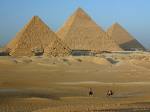
Probably the most famous image of Egypt is the sole survivor of the Seven Wonders of the World, the Pyramids of Giza still live up to more than 4000 years of hype. Their extraordinary shape, geometry and age render them somehow alien constructions; they seem to rise out of the desert and pose the ever-fascinating question, 'How were we built, and why?'.
Centuries of research have given us parts of the answer to this double-barrelled question. We know they were massive tombs constructed on the orders of the pharaohs by teams of workers tens-of-thousands strong. This is supported by the discovery of a pyramid-builders' settlement, complete with areas for large-scale food production and medical facilities. Ongoing excavations on the Giza Plateau are providing more and more evidence that the workers were not the slaves of Hollywood tradition, but a highly organised workforce of Egyptian farmers. During the season of the inundation, when the annual Nile flood covered their fields and made farm work impossible, the same farmers could have been redeployed by the highly structured bureaucracy to work on the pharaoh's tomb. The Pyramids can almost be seen as an ancient job-creation scheme, with the flood waters also making it easier to transport building stone to the site.
Egypt is on the list of the most popular places to visit and is certainly worth a trip to see and experience its wonders.


Egypt


For more information on some great deals on holidays to Egypt through Thomson Holidays - Click Here!


Bookmark & Share

Monday, February 8, 2010

Egypt - Some History

The regularity and richness of the annual Nile River flood, coupled with semi-isolation provided by deserts to the east and west, allowed for the development of one of the world's great civilizations. A unified kingdom arose circa 3200 B.C. and a series of dynasties ruled in Egypt for the next three millennia. The last native dynasty fell to the Persians in 341 B.C., who in turn were replaced by the Greeks, Romans, and Byzantines. It was the Arabs who introduced Islam and the Arabic language in the 7th century and who ruled for the next six centuries. A local military caste, the Mamluks took control about 1250 and continued to govern after the conquest of Egypt by the Ottoman Turks in 1517. Following the completion of the Suez Canal in 1869, Egypt became an important world transportation hub, but also fell heavily into debt. Ostensibly to protect its investments, Britain seized control of Egypt's government in 1882, but nominal allegiance to the Ottoman Empire continued until 1914. Partially independent from the UK in 1922, Egypt acquired full sovereignty following World War II. The completion of the Aswan High Dam in 1971 and the resultant Lake Nasser have altered the time-honored place of the Nile River in the agriculture and ecology of Egypt. A rapidly growing population (the largest in the Arab world), limited arable land, and dependence on the Nile all continue to overtax resources and stress society. The government has struggled to ready the economy for the new millennium through economic reform and massive investment in communications and physical infrastructure
For more information on some great deals on holidays to Egypt through Thomson Holidays - Click Here!


Bookmark & Share

Thursday, February 4, 2010

Desert Tours

The desert beckons but where and how will you go? I took a long time getting used to the idea that actually I could go anywhere in the desert. It is like the sea no one owns it and nothing stops you roaming in any direction. Nothing stops you except the need for water and fuel of some kind. I think it is best to think of the desert as a place where you walk. Certainly you can only experience its wonders when you are up close and personal with the sand and the rock. Driving and camel riding may get you to where you want to be but it will be your own legs that always complete both the outer and inner journey of a desert of quest. That said, the choice of transport depends on how deep you want to go into the desert and how much time you have. The tours listed below are a tiny fraction of what is possible. There purpose is to get you thinking. You can then start talking with guides and safari operators from a strong position of knowledge.


Thomson Holidays - Click Here!


Bookmark & Share